
Metals that matter,

for a healthier world

Annual Report and Accounts 2026

JM at a glance
Download our full report

Our purpose

Metals that matter,
for a healthier world

JM’s redefined purpose revolves around our global expertise in platinum group metals (PGMs) and the benefits these metals bring to people, communities and the environment. From providing air quality to enabling clean energy and transport to advancing cancer diagnostics, our PGM products and services are helping to create a healthier world.

Our purpose is about getting back to basics and simplifying our offer. Combined with our organisational restructure and strategic refresh, it provides a clearer sense of who we are, why we exist and what we need to do to deliver on our commitments. In short, it gives us the platform to perform; a foundation around which we can all align as we look to create a leaner, more focused and future-oriented JM.

Platinum grain texture

Our behaviours

Safety first, always

Nothing comes before the safety of our people and operators

Work together

We combine our skills and expertise to solve problems and perform at our best

Take accountability

No excuses.
We take ownership and responsibility to deliver for our customers

Drive results

We strip out complexity and tackle issues head on, to unleash our full potential

£2,555m

In sales

c.9,500

Employees across 28 countries
(at 31st March 2026, inc. CT business)

£12,573m

Revenue

£340m

Underlying operating profit1

£168m

Free cash flow1

85%

Sales contributing to our four priority UN Sustainable Development Goals (SDGs)

New purpose.

Refreshed strategy.

Focused delivery.

  1. Non-GAAP measures are defined and reconciled in note 34 of the financial statements.
Leadership statements
Download our full report
Andrew Cosslett

Andrew Cosslett

Chair

Andrew Cosslett

Delivering on our commitments

2025/26 was a pivotal year for Johnson Matthey (JM). We set out revised strategic ambitions, moved to leaner structures throughout the business and made significant changes to our management teams.

Responding and repositioning

Following the announced divestment of Catalyst Technologies (CT) in May 2025, the Company took strong action to reposition itself with investors. This included revised guidance with clear financial targets and a commitment to create increased shareholder value going forward. To deliver these objectives, the Company sharpened its focus on JM's core capabilities, solidified its position in key markets and began the work of driving higher levels of internal efficiency.

The process of renewal is underpinned by our revised purpose, 'metals that matter, for a healthier world'. The new articulation of our purpose, which followed the reshaping of our portfolio, was achieved with input from colleagues across the business and is designed to bring focus to our work. It also reflects the enduring pride that people at JM feel for what we do and the positive effect we have in the countries and communities where we operate. It is the central theme of this report.

As part of this renewal, the Board reviewed its governance arrangements to ensure they remain aligned with the Group's refocused strategy, with greater emphasis on integrated board oversight of sustainability, capital allocation, risk and execution as priorities become clearer.

Focused on execution

In a year of significant internal change and external challenge, the Company produced good financial results and delivered well against its revised financial commitments. We returned £129 million in dividends to shareholders during the year.

I took up the role of Chair in July 2025 and I consider it a privilege to be part of the great history of this organisation. I would like to pay tribute to my predecessor, Patrick Thomas, for his contribution and commitment over the seven years he was Chair. Since my arrival, the JM Board has continued to evolve. In January 2026, Alastair Judge was appointed to the Board as an Executive Director and Chief Financial Officer (CFO). Richard Pike was appointed Chief Operating Officer (COO), remaining an Executive Director.

As part of JM's strategic reset, the Board is focused on overseeing the ongoing process of transition. We are committed to supporting the management team to deliver its urgent priorities. These include the successful commissioning of our new refinery at Royston in the UK, the divestment of the CT business and the continued reshaping of JM for future success. Under the leadership of our Chief Executive, Liam Condon, the management team is well placed to execute the strategy we have set out and I look forward to helping them make the very best of the undoubted talent and resources we have at our disposal at Johnson Matthey.

Liam Condon

Liam Condon

Chief Executive Officer

Liam Condon

Reset, reshaped and refocused

2025/26 was a year of strategic reset for Johnson Matthey (JM), underpinned by solid performance. A year in which we announced a final agreement for the divestment and sale of Catalyst Technologies (CT) and made progress towards becoming a more streamlined, focused and cash-generative business, with sustainable returns.

Our performance in 2025/26

Despite challenging market conditions and a volatile geopolitical climate, we delivered a solid performance in 2025/26 and made good progress on our priorities, including working capital reduction and cash improvements. We increased underlying operating profit by 6% at constant platinum group metal (PGM) prices; delivered Clean Air margin improvement of 270 basis points to 14.5%; and Platinum Group Metal (PGM) Services margin of 28.3%. We also achieved run-rate breakeven for Hydrogen Technologies (HT), although evolving external dynamics led us to take additional impairments on the majority of our HT assets, reflecting slower market growth.

JM continued to take a conservative view of markets, focusing on improving profit, reducing costs and managing capex. Our focus is on controlling the controllables and not being dependent on market tailwinds to drive performance. With the foundations for our new cash-focused business model in place, we saw a material step-up in free cash flow, plus improved working capital across the Group and a reduction in overheads of c.£70 million. As a result, we are on track to deliver sustainable free cash flow of at least £250 million p.a. by 2027/28 and beyond.

Focusing on our core competencies

In late February 2026, we announced our agreement with Honeywell to extend the Long Stop Date for the sale of our CT business. We expect to complete the transaction by the end of August 2026, having agreed to sell CT at a revised enterprise value of £1,325 million. Since we first announced the transaction in May 2025, the market environment has changed, with significant headwinds impacting all players, including CT. In this context, we believe the revised agreement is a positive outcome, representing substantial value for JM and our shareholders.

The sale of CT is a major development for JM. It has presented a unique opportunity to reset our strategic direction and reshape our organisation. It has also enabled us to refocus on the organisation's core competencies. Post-CT, we are doubling down on the disciplines in which JM has excelled for over 200 years (precious metal chemistry and catalysis), further strengthening our market-leading positions in Clean Air and PGM Services. Previously, our combined portfolio of growth and value created a mixed picture for stakeholders. Now this picture is clearer, as we present a simpler, fully circular offering focused on driving value to our customers and investors.

However, these changes won't undermine our growth prospects. JM is leveraging its technological expertise and assets through the stability of its core markets, while pursuing capex-light growth optionality through Clean Air Solutions (CAS), Hydrogen Technologies and PGM Products.

Crucially, the Clean Air market has greater longevity than previously thought1, and we are building lasting partnerships with leading OEMs in this space. In 2025/26, we signed a major contract with a global manufacturer focused on the growing market segment of hybrid light-duty gasoline platforms. We also signed a significant new deal with a major US industrial company for off-grid power generation emission control.

In another important development, in May 2026 we announced the acquisition of CORMETECH Inc., the leading SCR catalyst manufacturer for stationary applications, for an enterprise value of $360 million. With a significant presence in the large and growing US power generation market, CORMETECH Inc. is expected to deliver strong growth in sales and profit in the near, medium and long term. Its acquisition will materially enhance the scale of our CAS business and create a global leader in stationary emission control, including for the rapidly growing data centre market.

Alastair Judge

Alastair Judge

Chief Financial Officer
Alastair Judge

Consistency and continuity in a time of change

2025/26 was characterised by consistent and disciplined delivery as we met our financial and commercial objectives while accelerating our transformation - notably the separation of Catalyst Technologies (CT), which we are now running as a standalone business in advance of its sale.

True to our course

We started to rebase the business in preparation for the sale of CT in June 2025. This process accelerated in January when we reshaped our leadership team with the establishment of a new Chief Operating Officer (COO) function, which provides greater continuity and strengthens our ability to meet our long-term value and cash commitments.

As Chief Financial Officer (CFO), my focus is on ensuring we remain true to our course; delivering the strategy we have laid out over the last 12 months and completing the reshaping of our business, including the functions directly under my remit, to execute against our objectives.

Driving value and efficiency through the sale of Catalyst Technologies

The operational separation of CT is already allowing us to create a leaner, more efficient organisation as we sharpen our focus on reducing overhead costs and working capital.

JM and Honeywell expect to complete the sale transaction by the end of August 2026 for the agreed price of £1,325 million. Once this is completed, we will return £1 billion to shareholders via special dividends of £800 million and the balance of £200 million through share buybacks. We will use the surplus proceeds to lower our net debt. However, with the cost of the compelling CORMETECH Inc. acquisition, we now only expect net debt / underlying EBITDA to fall to the level of 1.0 to 1.5 by 31st March 2029.

In accordance with standard accounting practice, we have classified the CT business as 'held for sale' and CT is also considered a discontinued operation. Its sale will ensure we deliver substantial value back to our shareholders, in line with our promises and priorities.

Solid performance, progressive improvement

From a financial performance perspective, in 2025/26 JM met market expectations, delivering year-on-year improvement. Revenue was £12,573 million, an increase from the prior year driven by higher metal prices.

Underlying operating profit - excluding the impact of platinum group metal (PGM) prices - grew 6%. Performance was largely driven by cost efficiencies across the Group. Average PGM prices increased during the year, with a benefit to underlying operating profit of £24 million. Including the impact of PGM prices, underlying operating profit grew 14%.

Our business model
Download our full report
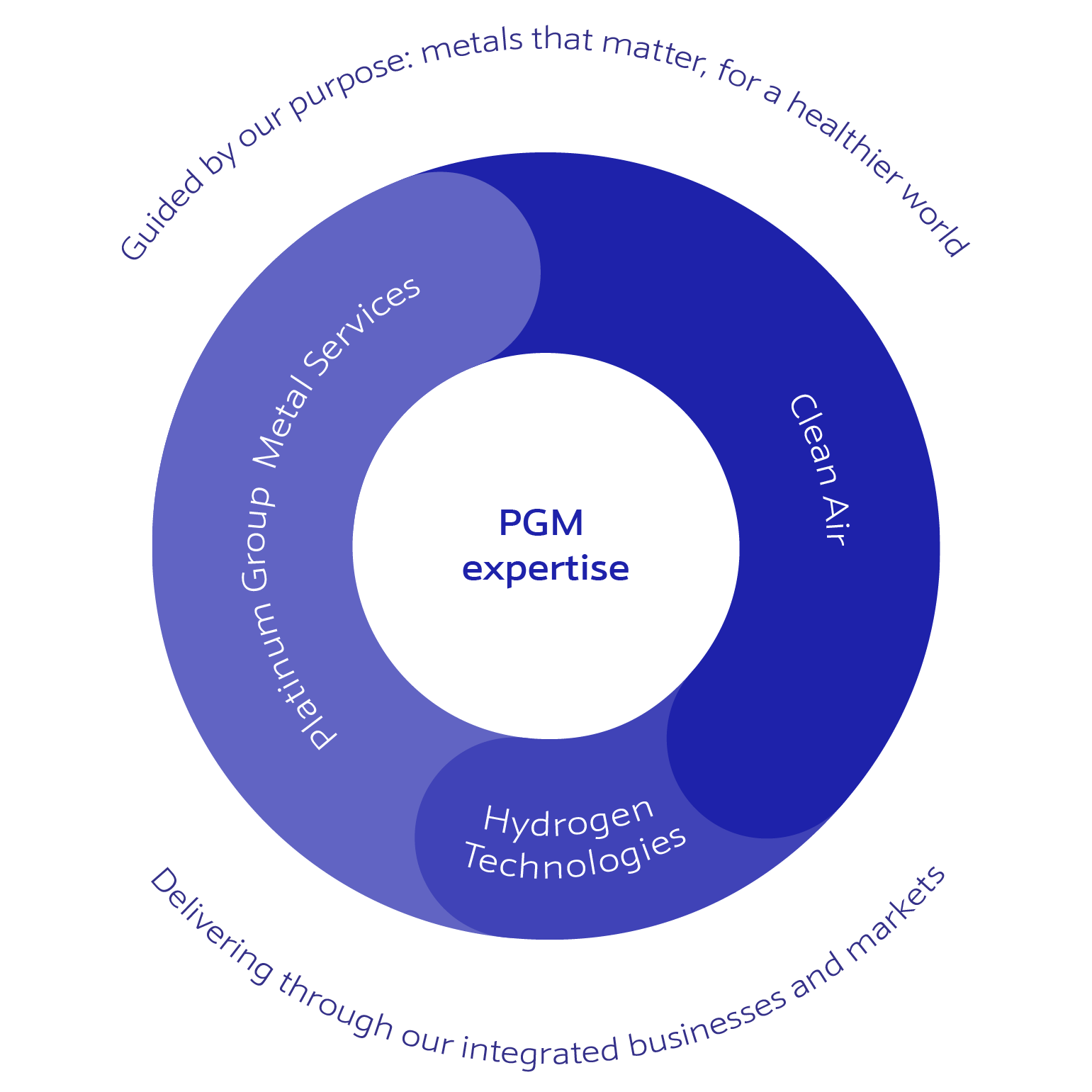
Business model pie chart showing PGM expertise segments: Clean Air, Platinum Group Metal Services, and Hydrogen Technologies
Leveraging synergies and competitive advantages

Expertise in metal chemistry

Everything we do across our three businesses is underpinned by our leadership in complex metal chemistry, catalysis and process engineering.

Mutual customers and partners

As our customers transition towards decarbonised energy systems, we provide a fully integrated and comprehensive offering through collaboration across our business units.

Shared technology and capabilities

We have approximately 2,400 R&D and engineering colleagues across all our businesses – with over 4,000 patents granted and more applications pending.

Foundational PGM ecosystem

We have deep insights into PGM markets through our Precious Metal Management team and our refining operations. A large share of the PGMs we use are sourced internally. This shared resource creates a resilient supply, lower exposure to price risk and efficient working capital.

Security of supply

Our customers count on us for a reliable supply of PGMs and recycling services. This is because we are the world's largest metal hub for PGMs, underpinned by our status as the leading recycler of PGMs.

A comprehensive sustainability offering

Every part of our business is committed to helping our customers adapt processes and products to reach the sustainability goals our society and planet are depending on.

Key performance indicators
Download our full report
Revenue
£12,573m
2025/26
12,573m
2024/25
11,022m
2023/24
12,284m

Revenue up, driven by higher precious metal prices.

Sales (excluding precious metals)
£2,555m
2025/26
2,555m
2024/25
2,831m
2023/24
3,360m

Sales down 7% at constant currency excluding Value Businesses, driven primarily by Clean Air with lower volumes mainly reflecting market softness. Sales in PGM Services were also down and this more than offset growth in Hydrogen Technologies.

Operating profit
£161m
2025/26
161m
2024/25
454m
2023/24
179m

Operating profit decreased by 65%, due to a number of one-off items in the prior year. These include the profit on disposal of Medical Device Components, partially offset by higher major impairment and restructuring charges.

Underlying operating profit
£340m
2025/26
340m
2024/25
299m
2023/24
335m

Good underlying performance with 6% growth, excluding the favourable impact of metal price (£24 million) and at constant foreign exchange rates (no impact). Strong cost savings and efficiencies across the Group enabling margin improvement.

Free cash flow1
£168m
2025/26
168m
2024/25
64m
2023/24
173m

Strong underlying cash flow generation driven by good underlying profit growth alongside reduced capital expenditure and continued reductions in working capital. (KPI linked to remuneration policy.)

(Loss) / Earnings per share1
(54.1)p
2025/26
(54.1)p
2024/25
176.0p
2023/24
26.1

Reported earnings per share decreased driven by major impairment and restructuring charges and deferred tax asset not recognised in the current year, resulting in a reported loss. (KPI linked to remuneration policy.)

Underlying earnings per share1
128.5p
2025/26
128.5p
2024/25
110.7p
2023/24
109.6

Underlying earnings per share increased by 16% driven by a lower average number of shares following the share buyback in the prior year and solid underlying performance.

Ordinary dividend per share
77p
2025/26
77.0p
2024/25
77.0p
2023/24
77.0p

Dividend per share maintained at the same level as prior year.

Key performance indicators are from continuing operations

1. Non-GAAP measures are defined and reconciled in note 34 of the financial statements.

Sales contributing to our four priority UN Sustainable Development Goals (SDGs)
85%
2025/26
85%
2024/25
82%
2023/24
89%

The increase this year reflects changes in the overall sales mix. Differences in market performance led to a higher share of sales aligned with our four priority UN SDGs, with stronger contributions from areas more closely linked to these goals. Please see https://sdgs.un.org/goals for more details on the UN SDGs.

R&D spend contributing to our four priority SDGs
85%
2025/26
85%
2024/25
87%
2023/24
92%

We saw a decrease in R&D spend against our priority UN SDGs as we continue to focus on UN SDG-aligned innovation.

Total Scope 1 and 2 greenhouse gas (GHG) emissions (market-based)
236,859 tCO2e
2025/26
236,859
2024/25
246,533
2023/24
281,912

Total Scope 1 and 2 GHG emissions decreased this year compared with the previous year, driven by reductions in Scope 1 emissions resulting from operational efficiencies and changes in product mix. (KPI linked to remuneration policy.)

Total Scope 3 (Category 1) purchased goods and services GHG emissions
2,911,366 tCO2e
2025/26
2,911,366
2024/25
3,098,366
2023/24
3,283,140

Our GHG emissions from Scope 3 purchased goods and services were lower than last year, reflecting changes in purchasing behaviours and business requirements.

GHG emissions avoided from using JM technologies (compared to conventional offerings)
2,274,248 tCO2e
2025/26
2,274,248
2024/25
1,606,644
2023/24
1,335,881

This financial year over 2.27 million tonnes of GHG emissions were avoided in customer products, aided by JM technologies or services. See our Sustainability Performance Databook for more details. (KPI linked to remuneration policy.)

Recycled PGM content in JM's manufactured products
73%
2025/26
73%
2024/25
76%
2023/24
69%

The rate of recycled PGM content in our manufactured products was 73%, down from 76% in 2024/25, reflecting cyclical refining patterns and scheduled production downtime that increased the use of primary material.

Total recordable injury and illness rate (employees and contractors)
0.47
2025/26
0.47
2024/25
0.36
2023/24
0.36

The year-end total recordable injury and illness rate (TRIIR) is 0.47, above that of the past two years. The increase reflects higher slip, trip and fall injuries in January-February 2026, more ergonomic cases, and reduced office-based hours1 worked following organisational changes this year. (KPI linked to remuneration policy.)

Female representation across all management levels
32%
2025/26
32%
2024/25
32%
2023/24
30%

Female representation at all management levels remains at 32% this year compared with the previous year. We remain committed to achieving our target of 40% by 2030. (KPI linked to remuneration policy.)
Download our Sustainability Performance Databook

1. Office-based workers are less exposed to safety hazards and hence less likely to get injured compared to, for example, plant-based workers.

Our strategy
Download our full report
Strengthening our core

Strengthening our core.
Building for the future.

JM’s refreshed strategy aims to generate cash, drive growth and deliver sustainable value to 2035 and beyond.

In early 2026, we refreshed our strategy, looking to add greater depth, align with the market environment and present our short- to medium-term outlook for the business. Refocusing our activities, this strategic refresh supports the launch of the new JM: a highly focused, lean and cash-generative business delivering materially enhanced shareholder returns.

Our refreshed strategy is focused on ensuring longevity across our three strategic horizons, Core, Scaling and Emerging, with a commitment to generate a minimum of £250 million p.a. in cash and £200 million of shareholder returns in and beyond 2027/28.
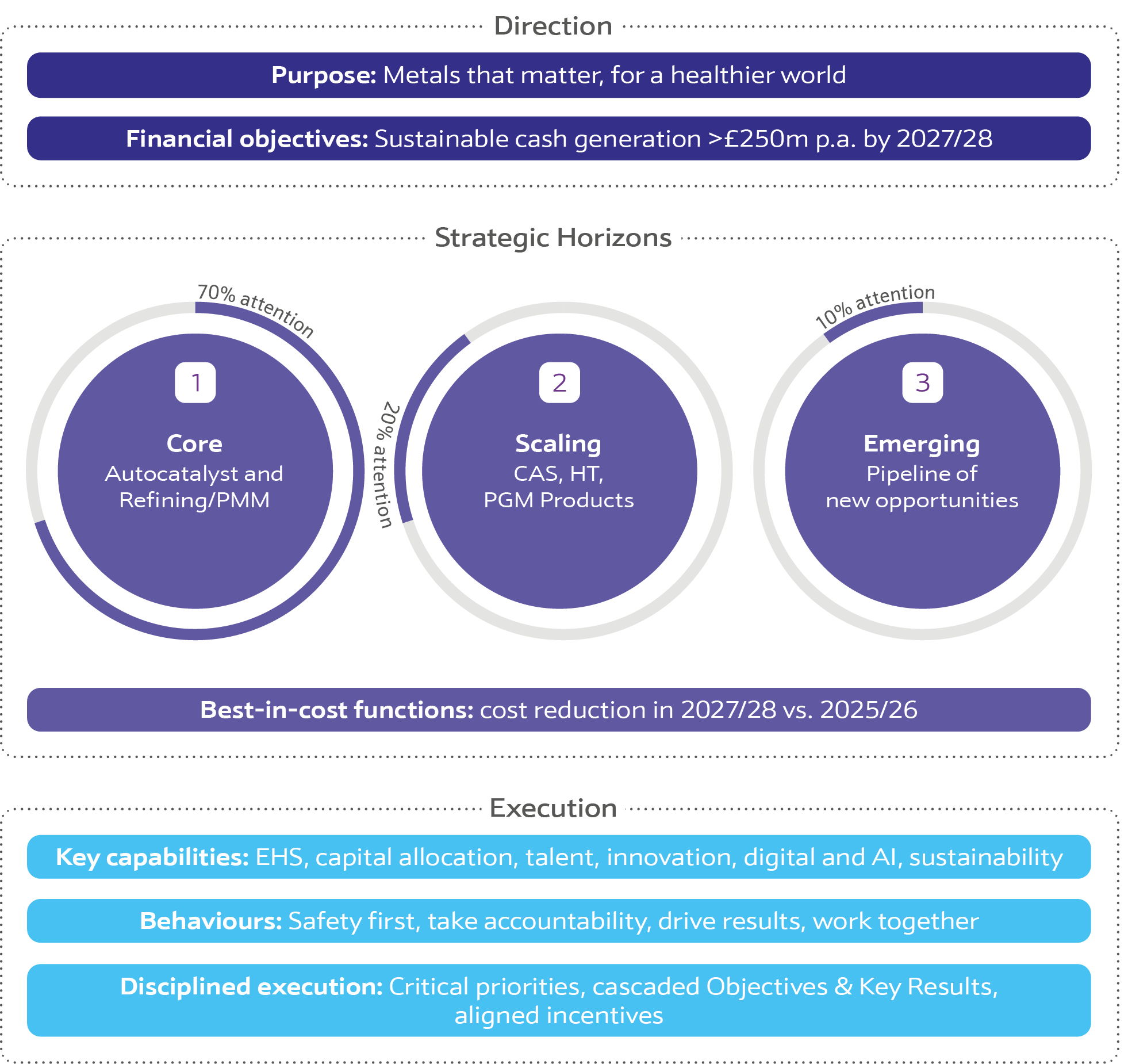
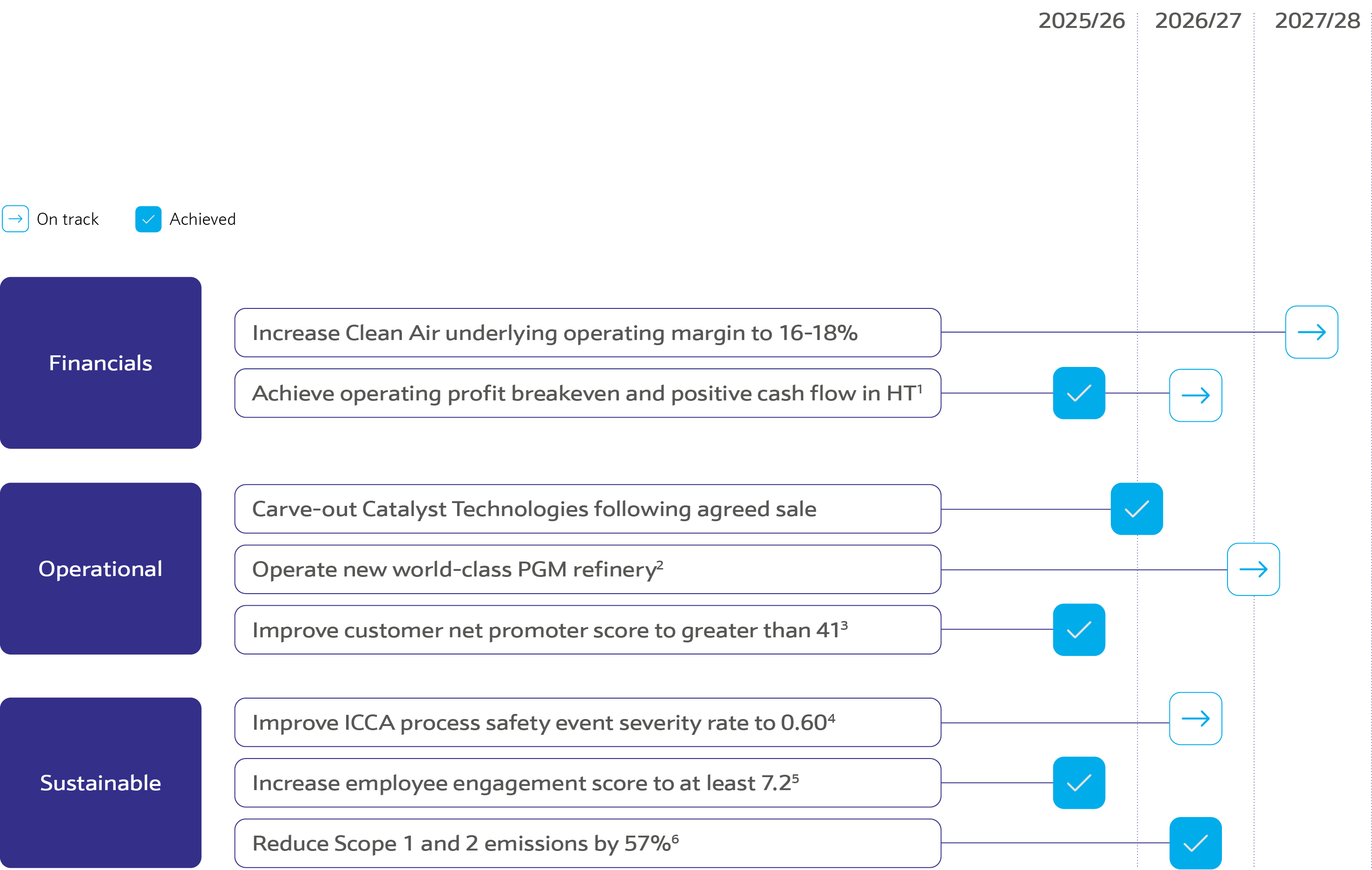
Our strategy direction
Strategy diagram
  1. Achieved run-rate operating profit breakeven in Q4 2025/26. On track to be cash flow positive in 2026/27. Cash flow is underlying operating profit plus depreciation and amortisation (EBITDA), less capex and net working capital movements.
  2. Expect new refinery to be operational in calendar year 2027.
  3. Net promoter score is a market research survey metric to measure customer satisfaction and loyalty, calculated from our annual customer survey data. 2025/26: 47, 2024/25 baseline: 41.
  4. ICCA - International Council of Chemical Associations. 2024/25 baseline: 0.74 (restated - previously 0.78).
  5. Employee engagement - March 2026: 7.5, March 2025 baseline: 7.1.
  6. Metric tonnes of greenhouse gases. 2025/25: 101,010 tonnes CO2 equivalents. This represents a 59% reduction compared to 2019/20 baseline of 248,432 tonnes (restated - previously 249,465 tonnes).
Sustainability at a glance
Download our full report
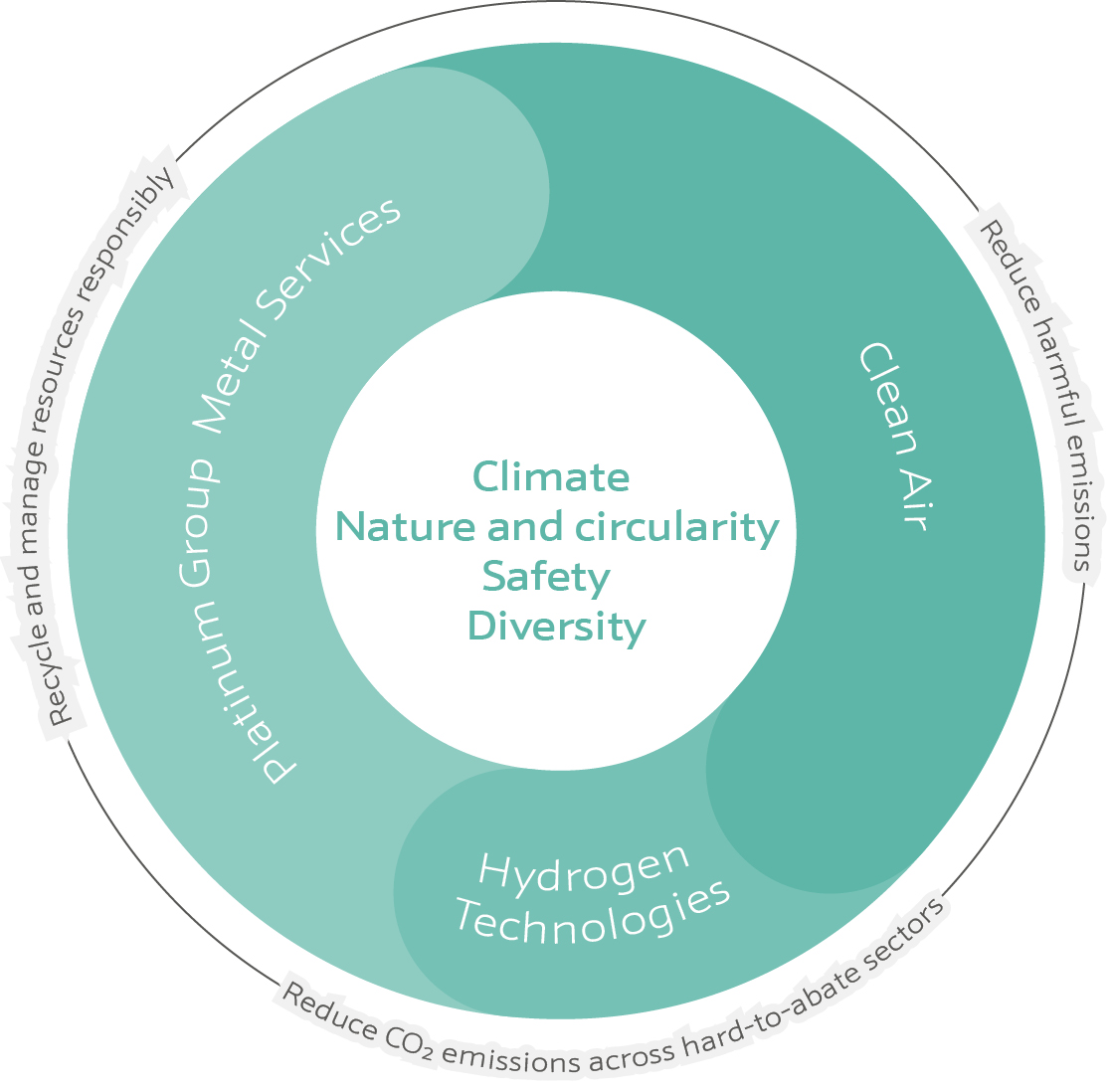
Sustainability pie chart showing PGM expertise segments: Clean Air, Platinum Group Metal Services, and Hydrogen Technologies

Sustainability is fundamental to JM's strategy. For over 200 years, our expertise in metal chemistry has helped to solve some of the world's most complex challenges.

As expectations around sustainability continue to evolve, we are adapting accordingly – taking a pragmatic, agile and commercially grounded approach to environmental, social and governance (ESG) matters.

Our sustainability priorities — climate, nature and circularity, safety, and diversity — are embedded into how we operate, how we manage risk and how we allocate capital. By integrating these priorities into decision-making across the business, we strengthen resilience, support innovation, and create long-term, sustainable value for our customers, employees, investors and wider society.